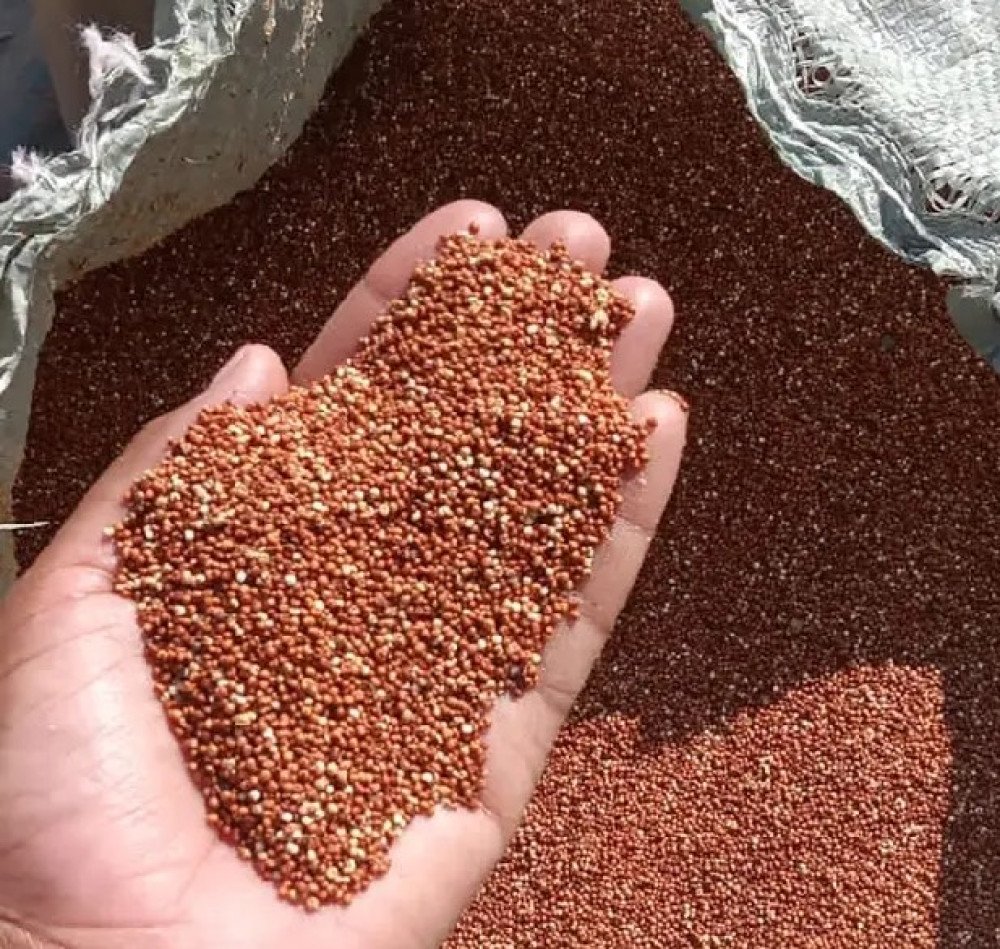
Putting this into just about three thousand words felt impossible at first. Thanks to a little AI collaboration, we made it happen. So sit tight, grab a glass of water, and let me walk you through the grasses that shaped continents and kitchens alike.
This is still part of our Palatable Grasses series, but with a small detour, a deep dive into one remarkable grain. You might remember it as our recent Grain of the Month. Now it’s time to slow down and really explore its world.
1. World prologue ~ the grass that waited for its moment
Long before rice paddies glimmered or wheat fields rippled, small bands of hunters roamed prehistoric lakes and noticed a grass whose seeds hung in neat clusters, ready to eat straight from the stalk. No threshing floors, no grinding stones, just a handful of sweetness pulled from the air.
That humble beginning birthed {millet}: not one grain, but an orchestra of them, each tuned to a different corner of the earth. From the Loess Plateau of northern China to the Ethiopian highlands, and from the Sahel to the Indian subcontinent, millets spread quietly, feeding empires, sustaining communities, and now, delighting chefs and health enthusiasts worldwide.
This blog is a deep-dive: every major millet type, the soils it loves, the tongues that speak its name, and the flavours it quietly lends to porridges, breads, beers, and baby food from Lagos to Laos. I hope I have done it justice thanks to the challenge I got from Munyu ~ blog fan, after I did the previous post on Finger millet. (I will redo this again)
2. The big family portrait ~ meet every colour
Think of millet as cousins who share the same grandfather: drought-proof, gluten-free, small-seeded, and incredibly versatile.
2.1 Pearl millet ~ the desert camel
Botanical name ~ Pennisetum glaucum
Looks like: a fat candle of seeds, 30–40 cm long, colours from champagne to deep grey.
Origin: Sahelian Africa, 5,000 BCE. Farmers selected for big seeds and long spikes to survive the desert.
Signature trait: thrives on as little as 250 mm of rain, loves 40 °C heat, tolerates salty soils.
2.2 Finger millet ~ the highland painter
Botanical name: Eleusine coracana
Looks like: a hand, five to nine fingers lined with tiny maroon seeds.
Origin: Ethiopian highlands, 3,000 BCE. Farmers prized its sweetness and the way seeds stay on the head until harvest.
Signature trait: turns porridge lavender; contains more calcium than milk gram-for-gram.
2.3 Foxtail millet ~ the polite plume
Botanical name: Setaria italica
Looks like: a soft fox tail, golden to light brown, seeds cling lightly.
Origin: Northern China, 6,000 BCE. Fed Great Wall builders and farmers of the Yellow River.
Signature trait: cooks in 15 minutes; flavour like lightly toasted hazelnuts.
2.4 Proso millet ~ the popcorn cousin
Botanical name: Panicum miliaceum
Looks like: small, round, shiny seeds – yellow, cream, or red.
Origin: Central Asia to Europe by 3,000 BCE. Chosen for quick ripening (60 days).
Signature trait: pops like popcorn; mild, almost rice-like taste.
2.5 Fonio ~ the world’s fastest food
Botanical name: Digitaria exilis (white), D. iburua (black)
Looks like: sand grains, smaller than sesame seeds.
Origin: West African savannas; first tended by women gathering “hungry rice.”
Signature trait: cooks in 6 minutes; flavour like a cross between popcorn and roasted nuts.
2.6 Teff ~ the Ethiopian pin-head
Botanical name: Eragrostis tef
Looks like: tiny as a poppy seed, ivory to deep chocolate.
Origin: Ethiopian highlands, 2,000 BCE. Thrives above 2,000 m.
Signature trait: 17 % protein, 14 % iron; ferments into injera.
2.7 Little/barnyard millet ~ the rice impostor
Botanical name: Echinochloa spp.
Looks like: miniature brown rice; cooks fluffy.
Origin: India and Myanmar, 1,000 BCE. Farmers wanted a crop that flooded like rice but didn’t need transplanting.
Signature trait: cooks in 12 minutes; neutral flavour that absorbs spices.
2.8 Kodo millet ~ the forest survivor
Botanical name: Paspalum scrobiculatum
Looks like: oval grey-brown seeds with a faint stripe.
Origin: Central India’s humid forests; tolerates shade and acidic soils.
Signature trait: high fibre; traditionally used for diabetes control in Ayurveda.
3. World footprints ~ where each millet feels at home
3.1 The Sahel Belt ~ pearl millet’s kingdom
Countries: Senegal, Mali, Burkina Faso, Niger, Chad, Sudan
Climate: 300 mm rainfall, 45 °C peak, sandy soils.
Cultural badge: “bajira” (Niger), “gero” (Nigeria), “mahangu” (Namibia).
Signature dish: fura; fermented pearl-millet balls dunked in sweetened yoghurt.
3.2 Ethiopian & Kenyan Highlands ~ finger millet & teff
Altitude: 1,500–3,000 m; cool nights, volcanic soils.
Finger millet: baby porridge (uji wa wimbi), beer (busaa), mixed breads.
Teff: injera flatbread, Ethiopian staple and cultural symbol.
3.3 Indian Subcontinent ~ foxtail, proso, little, kodo
States: Karnataka (ragi), Tamil Nadu (foxtail), Uttar Pradesh (proso), Jharkhand (kodo), Odisha (little)
Dishes: ragi dosa, korralu payasam, samai~ lemon rice.
3.4 Chinese & Mongolian Steppes ~ foxtail & proso
Climate: short summers, –20 °C winters, 250 mm rain.
Use: xiao mi congee; proso popped for street snacks.
3.5 West African Savannah ~ fonio
Countries: Senegal, Guinea, northern Côte d’Ivoire, southern Mali
Climate: 6-week rainy window; poor soils.
Cultural badge: acha (Nigeria), fonio (Senegal); called “seed of life” by female farmers.
3.6 Southern African drylands ~ pearl & finger stronghold
Countries: Namibia, Botswana, Zimbabwe, South Africa, Mozambique
Dishes:mabel (pearl), zviyo (finger), bogobe jwa mabele porridge, malted for bojalwa beer.
3.7 North American prairies ~ proso’s playground
States: Colorado, Nebraska, South Dakota
Uses: bird seed, gluten-free beer, crunchy cereal topping.
4. African millet epic ~ region-by-region, grain-by-grain
4.1 North Africa ~ oases, pharaohs, and purple breakfast
Pearl millet: juice bars sell “desert milk” smoothies.
Finger millet: experimental farms produce purple ragi flour for “pharaonic porridge.”
Teff: Ethiopian injera, also trending as green juice in Alexandria gyms.
4.2 West Africa ~ fonio sprints and pearl rules
Fonio: harvested in 6 weeks; chefs call it “West African quinoa.”
Pearl millet: “bajira” fermented into fura balls.
Finger millet: “tamba” roasted and ground with groundnuts for milo powder.
4.3 East & Central Africa ~ the purple kingdom
Finger millet: uji wa wimbi, Kenya’s national baby food.
Teff: injera exported to Nairobi; bars blend teff greens with mango for “highland shot.”
Foxtail millet: popped and sprinkled on yoghurt.
4.4 Southern Africa ~ gold and tiny giants
Pearl millet: malted for infant cereal Mabela; fermented for bogobe porridge.
Finger millet: Zimbabwe zviyo porridge; kids love purple.
Fonio: pilot plots in Mozambique/Zambia; NGOs teach careful harvesting.
4.5 Common threads
All millets are [C4 grasses]: heat-loving, water-efficient.
Every region has a purple porridge story (finger millet anthocyanins).
Fermentation rules: Ethiopian injera, Nigerian fura, West African fonio – time + microbes = probiotic gold.
5. From porridge to patient ~ medicinal uses
5.1 Traditional preparations
Sprout juice: 10-day shoots blended; iron-rich tonic.
Fermented gruel: 48-hour soak; gut-friendly probiotics.
Malt syrup: sprouted, dried, boiled; cough remedy.
Warm poultice: cooked grain wrapped in cloth for aches.
5.2 What healers say ~ and what labs find
1. Bone & blood (finger, teff) – 10× calcium of milk; Indian trials show higher haemoglobin in toddlers.
2. Sugar control (pearl, fonio) – low GI 54–68; Ghanaian trial: 12 % lower post-meal glucose.
3. Gut garden (all) – fermented millet increases ‘Lactobacillus’.
4. Antioxidants (purple finger, red pearl, black teff) – rival blueberries; ORAC 3,000 µmol TE/100 g.
5. Heart help (proso, pearl) – beta-glucans lower LDL by 8 %.
6. Lactation lift (finger) – Kenyan mothers drink ‘uji wa wimbi’; animal models show mild prolactin boost.
5.3 Safety notes
Gluten-free, coeliac-safe.
Finger & pearl: moderate oxalate; rotate.
Teff: high calcium; thyroid meds leave 4-hour gap.
High-tannin pearl can reduce iron absorption – pair with vitamin C.
6. Kitchen play ~ cooking each type
Pearl millet ~ savoury & versatile
Flour: replace 1/3 wheat in bread.
Pop: dry pan till it pops; salad topping.
Porridge: 1:3 flour to water, beat ~ Sudanese kasha.
Finger millet ~ the purple hero
Baby ‘uji’: soak 6 h, blend, simmer.
Energy balls: roast, blend with dates, roll in coconut.
Pizza base: cook into stiff porridge, cool, press, top, bake.
Foxtail millet ~ polite plume
Rice sub: boil 1:2 water, fluffy.
Milk: blend cooked grain, strain.
Proso millet ~ popcorn cousin
Breakfast cereal: pop, mix with honey/nuts.
Thickener: soup or stew glue.
Fonio ~ fastest food
5-minute side: boil 1:1.5 water; fluffy.
Pudding: coconut milk + cacao.
Teff ~ tiny powerhouse
Injera: ferment 2 days, cook like pancake.
Porridge: simmer whole grain with milk; caramel flavour.
Little/barnyard millet ~ rice impostor
Salad base: boil like couscous.
Stuffing: cook with onion, herbs; fill peppers/tomatoes.
Kodo millet ~ forest survivor
Risotto: simmer slowly in mushroom stock.
Diabetes-friendly rice: cook 1:2.5 water, cool, reheat.
7. DIY baby-friendly finger millet porridge
1. Rinse ½ cup grain, soak 6 h (reduces phytic acid).
2. Drain, blend with 2 cups water until smooth.
3. Simmer 15 min, stir constantly; add breast milk/formula for desired texture.
4. Cool slightly – natural purple amazes kids.
Add your reply
Replies