There are few things more beautiful than eating together. Not merely occupying the same room with separate plates, but truly together, hands reaching, voices overlapping, the meal itself becoming a conversation. In African culture, this act has been celebrated for millennia. It is not nostalgia. It is how we built belonging long before we had words for it.
To understand communal eating in Africa, one must understand the sinia. In Swahili, the word refers to a large, round platter, often metal, sometimes carved from wood, used to serve food for many hands at once. But the word has an older, more surprising origin. In fine-dining English, "sinia" traces back to "silver server", the raised, polished dish a butler might carry to a lord's table. The servant held it; the master ate from it. Hierarchy made visible.
Africans looked at that object and repurposed it entirely. The sinia became not a servant's tool but a communal throne. Enlarged, flattened, and generous enough to hold a family's entire meal, it was placed at the centre of the gathering. No servant stood nearby. Everyone served themselves. Everyone ate together. The sinia was democratised.
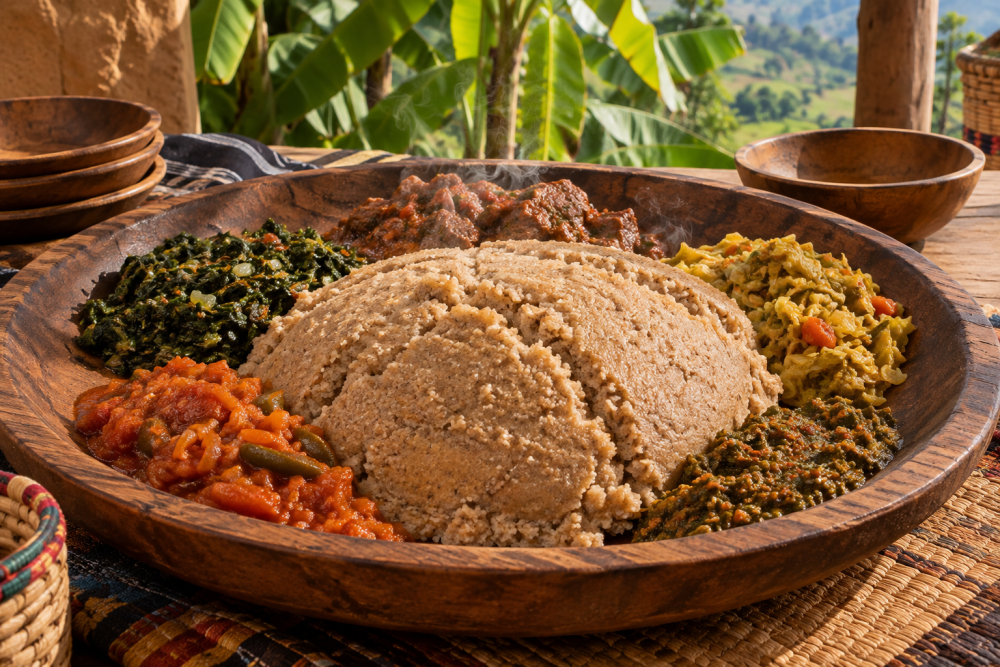
So when I speak of the sinia, I do not mean a silver dish for one. I mean the vast platter; metal, wood, or woven, that holds ugali, greens, stew, perhaps fermented porridge, into which multiple hands dip simultaneously. The boundary between "mine" and "yours" dissolves. The meal becomes a single organism.
This month, our ingredient was sorghum. As I explored this remarkable grass, one of humanity's oldest cultivated cereals, I kept stumbling into the same image: people gathered around a single vessel, eating together.
Sorghum ugali, thick and steaming, broken into communal chunks. Sorghum beer, busaa or dolo, passed from mouth to mouth in a single gourd. Sorghum porridge, uji, ladled from the same pot at dawn. The grain and the gathering were inseparable.
This is not unique to sorghum cultures. Across the continent, the pattern repeats:
In Ethiopia, injera spreads across a mesob basket, with multiple hands tearing and scooping from the same flatbread surface (McCann, 2009).
In Senegal, thieboudienne arrives on a single platter, with diners eating from the side facing them and the centre left for honoured guests (Wilkerson, 2013).
In Nigeria, pounded yam and soup sit before a Yoruba family, with the eldest breaking the first piece, establishing both hierarchy and unity (Ojo, 2017).
The anthropologist Mary Douglas once wrote that "a meal is a social event, not merely a biological necessity" (Douglas, 1972). In African communal eating, this becomes tangible. The plate is the village. The hand that reaches across it is the bridge.
I did not learn this from books. I learned it from my grandmother.
Once she finished cooking, she would announce: "Chakula ni cha watu wangu", the food is for my people. She served everything onto one large platter. We children gathered, elbows touching, and dove in. The choosy eaters, my cousin among them, somehow ate more when the food was shared. The competition was friendly. The approval was immediate. You could not hide behind your own plate because there was no hiding place.
I did not know then what I know now: communal eating is not merely a cultural preference. It is therapeutic.
In 2015, researchers at the University of Oxford found that the more often people eat together in communal settings, the higher their reported life satisfaction and social bonding (Dunbar, 2015). The mechanism, they proposed, is endorphin release triggered by physical proximity, shared rhythm, and the simple act of eating together.
Even more specifically, communal eating has been explored as a treatment for anorexia nervosa and other restrictive eating disorders. A 2018 review in the *International Journal of Eating Disorders* noted that "family-style and communal meals reduce anxiety around food, increase intake, and model healthy eating behaviours" (Le Grange & Lock, 2018). The sinia, in other words, was doing clinical work before clinics existed.
Consider the logic. Anorexia thrives on isolation, control, and rigid boundaries between self and other. The sinia dissolves all three. You cannot control portions when the plate is shared. You cannot isolate when your hand touches your brother's. You cannot maintain rigid boundaries when the stew pools together.
My grandmother was not a therapist. But her platter was.
It would be dishonest to ignore the complications. Urban life, with its smaller kitchens and busier schedules, has pushed many families towards individual plates. Hygiene concerns, legitimate, especially after recent years, make shared vessels seem risky. And global dining aesthetics privilege the individual plate, the arranged meal, the personal experience.
But must hygiene and aesthetics erase the sinia entirely?
I do not think so. Consider:
The Ethiopian gursha: a practice where diners feed each other by hand, the ultimate expression of trust and care. It has survived urbanisation because it was never framed as primitive; it was framed as honour.
The Korean ssam: lettuce wraps assembled at the table, shared side dishes, and communal grilling. South Korea is as modern as any society, yet communal eating thrives because it was branded as sophisticated, not backward.
The rise of "family-style" dining in Western restaurants: large plates meant for sharing, now marketed as "experiential dining" and priced at a premium. What was once called "developing world eating" is now sold as trendy.
The sinia does not need to be rescued from modernity. Modernity needs to be reminded that the sinia was always modern.
I have begun serving sorghum ugali on one plate again. I cut it into rough pieces. Each hand reaches, grabs, dips into the stew, and travels directly to the mouth. It is not elegant by Michelin standards. But it is beautiful by every standard that matters.
For uji (porridge) I am still negotiating with myself. The hygiene question feels more acute with liquids. But I am willing to experiment: individual cups poured from the same pot, perhaps, or small gourds passed in sequence. The principle matters more than the vessel.
And who knows? Perhaps the sinia will become fashionable again. Not as nostalgia, not as anthropology, but as choice, the way sourdough bread and natural wine returned not because they were old, but because they were good.
If you are reading this and the image of multiple hands in one plate makes you recoil, I understand. It is, as I admitted, strange to the uninitiated. But so is any intimacy before it becomes familiar.
The sinia is not merely about food distribution. It is about risk and trust. You cannot share a plate without trusting the hands that reach beside yours. You cannot eat together without becoming, however briefly, inseparable.
My grandmother knew this. Science now confirms it. And sorghum: humble, drought-resistant, ancient sorghum carried the lesson all along.
I will keep sharing from one plate. I invite you to try it, at least once, with people you trust. The food tastes different. I promise.


Add your reply
Replies